

Terrazzo is the surface that never forgets every chip of marble, glass, or shell is a memory pressed into stone, then polished until it shines.
Few materials carry the weight of history and the freshness of the moment quite like terrazzo. Born centuries ago on the terraces of Venetian craftsmen who swept up marble offcuts and set them in clay underfoot, terrazzo has been reinvented repeatedly, and in 2026, it is experiencing yet another evolution that is its most exciting yet.
This year, terrazzo is no longer a floor. It is a wall, a countertop, a pendant light, a bathroom surround, a side table, and a stair riser. It comes in earthy palettes built for calm, and in electric combinations designed to provoke. It is made from recycled glass, crushed seashell, bio-resin, and reclaimed stone. The terrazzo design trends 2026reflect a material finding its fullest, most liberated expression — and the results are genuinely breathtaking.
Here is your complete guide to every major terrazzo trend shaping interiors this year, from the chips and the colors to the spaces where this ancient-modern material is making its boldest statement yet.
01. The Rise of Oversized Chip Terrazzo
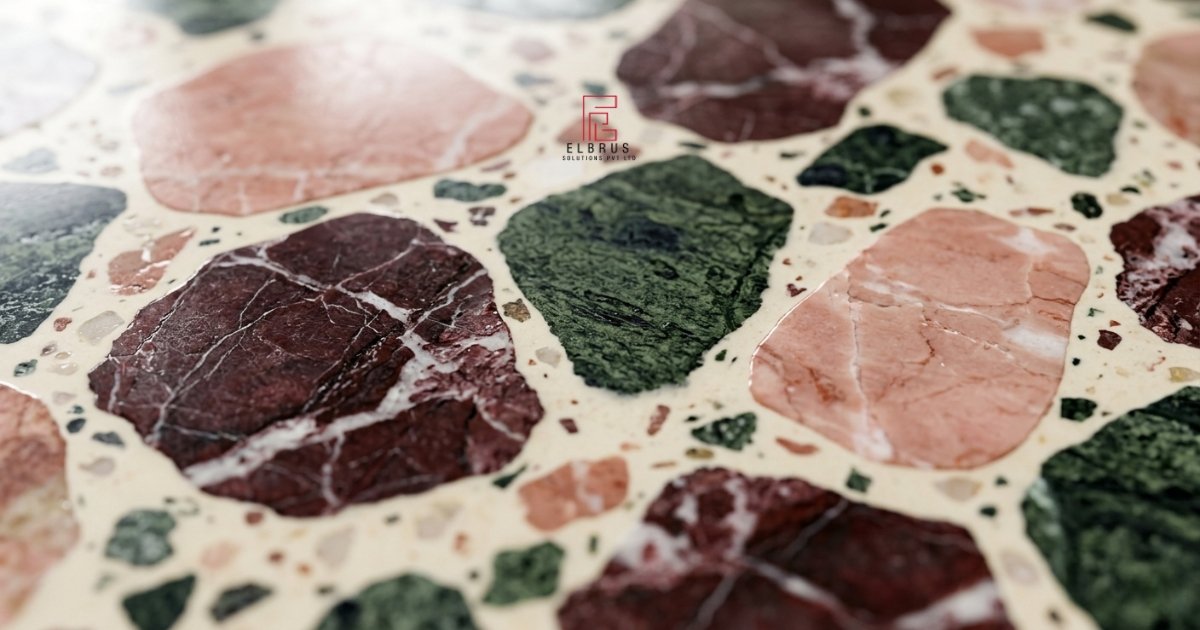
For decades, terrazzo was defined by fine, confetti-like fragments — tiny chips of marble and glass set close together in a dense, controlled matrix. In 2026, that convention is being deliberately shattered. The dominant pattern trend this year is macro-chip terrazzo — large, bold fragments ranging from 20mm to 60mm in diameter that give the surface a raw, expressive character unlike anything seen in the material’s recent history.
These oversized inclusions create a completely different visual rhythm. Where traditional terrazzo reads as a smooth, patterned texture from a distance, macro-chip terrazzo demands attention at every scale — each fragment is large enough to be appreciated individually, like a mosaic made of geological specimens. When those fragments include richly veined Calacatta marble, translucent green onyx, or deep burgundy quartzite, the effect is spectacular.
Designers are pairing this bold chip scale with calm, monochromatic binder colours — soft warm white, pale putty, or matte charcoal — so the aggregate does all the talking without the whole surface becoming visually chaotic.
✦ Design Application Notes
- Floor scale: Macro-chip terrazzo reads best in large, open-plan spaces where the pattern has room to breathe — hallways, open kitchens, loft living areas.
- Feature walls: A single wall of oversized-chip terrazzo panels makes a gallery-worthy statement in dining rooms or behind a bed headboard.
- Pair with smooth, quiet materials — plastered ceilings, linen upholstery — to balance the visual complexity of the surface itself.
02. Earthy Tonal Palettes The New Terrazzo Color Story
The terrazzo color story of 2026 is written in the language of the earth — warm umbers, dusty blushes, sage greens, rusted terracottas, and the deep chalky blues of old Mediterranean plaster. This is a decisive move away from the pastel brights and confetti primaries that dominated terrazzo’s recent revival, toward something more grounded, more permanent, and more emotionally resonant.
The most requested palette combinations this year include sand-and-sienna (warm beige binder with terracotta and ochre chips), sage-and-linen (pale green binder with cream and dusty rose aggregate), and midnight-and-copper (deep charcoal or near-black binder with warm bronze glass and rose quartz chips). These combinations feel simultaneously ancient and current — they could belong to a Roman bath or a 2026 boutique hotel and feel equally at home in both.
- Fired Sienna
- Warm Blush
- Herb Sage
- Dusty Stone
- Deep Umber
- Adriatic Teal
- Raw Linen
An important nuance in 2026’s terrazzo color approach is the concept of tonal layering — choosing chips and binders that are close in value but different in hue, creating surfaces that appear almost monochromatic from a distance but reveal rich complexity up close. This quiet sophistication marks a significant maturation in how the material is being used.
✦ Color Pairing Guide
- For calm spaces (bedrooms, reading rooms): sage binder + linen and dusty rose chips + white marble fragments.
- For lively spaces (kitchens, hallways): warm ivory binder + terracotta, sienna, and forest green chips.
- For drama (bathrooms, bars): near-black binder + rose quartz, copper glass, and pale grey chips.
03. Terrazzo Beyond the Floor Walls, Furniture & Objects
Perhaps the single biggest shift in terrazzo’s trajectory in 2026 is its liberation from the floor plane. While terrazzo flooring remains the most widely specified application, the material’s most exciting uses this year are happening vertically and three-dimensionally — on walls, countertops, bathroom surrounds, staircase cladding, and even as the primary material in furniture and decorative objects.
Terrazzo Walls: Thin-gauged panels for feature walls in dining rooms, hotel lobbies & retail
Kitchen Countertops: Engineered terrazzo slabs replacing quartz in modern kitchen design
Bathroom Surrounds: Full wet-room terrazzo — floor, walls, and shower tray in one seamless pour
Furniture Pieces: Side tables, plinths, and bench seats cast directly in terrazzo
Stair Cladding: Terrazzo treads and risers — a grand entrance statement
Decorative Objects: Terrazzo vessels, trays, lamp bases, and architectural hardware
The kitchen is where terrazzo is making its most dramatic inroads beyond the floor. Terrazzo design trends 2026 in engineered resin formats are now competing directly with quartz and marble for the kitchen island specification — offering a surface that is more visually distinctive than quartz and considerably more durable than natural marble in a working kitchen context.
04. Sustainable Bio-Resin & Recycled Terrazzo
The sustainability imperative is reshaping every corner of the materials industry in 2026, and terrazzo is no exception. In fact, the material is uniquely positioned to lead the conversation — its fundamental premise (setting off cuts and waste fragments in a binding matrix) is a form of circular design that was sustainable long before that word became fashionable.
This year’s most progressive terrazzo producers are taking that ethos further with bio-resin binders derived from plant-based or recycled polymer systems, replacing petroleum-based epoxy resins that have traditionally been the standard for precast terrazzo panels. These bio-resin systems deliver comparable performance, lower embodied carbon, and — crucially — a slightly warmer, more organic surface quality that resonates with the material’s natural aesthetic.
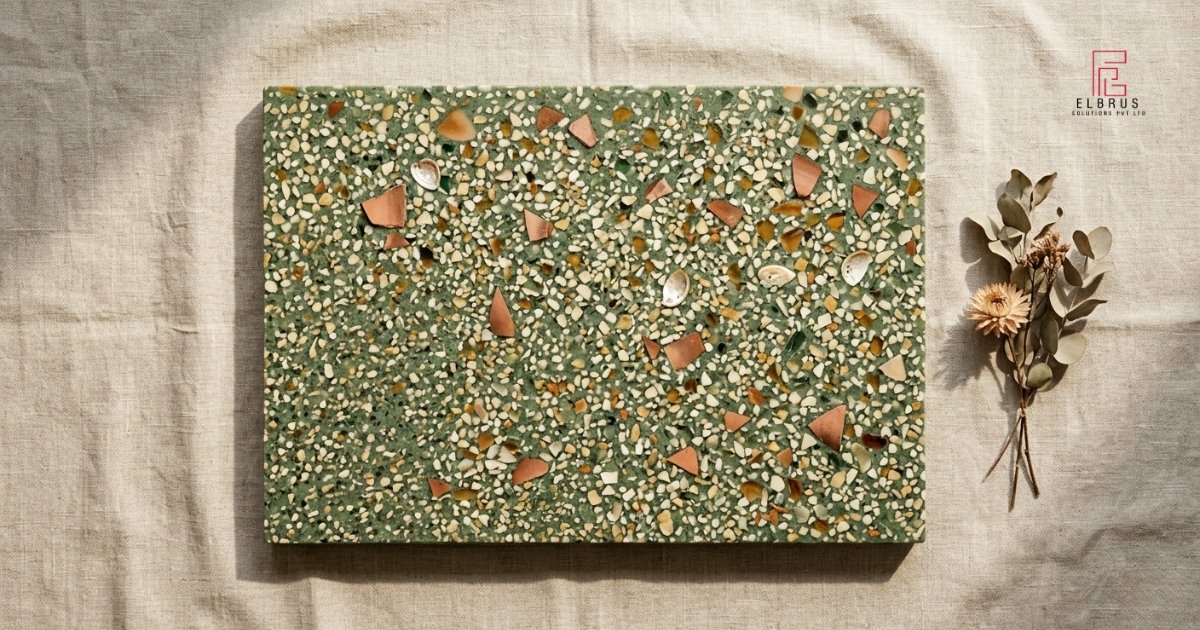
The aggregate story is equally compelling. Designers in 2026 are specifying terrazzo made from post-consumer recycled glass (particularly from wine bottles and architectural glazing offcuts), crushed seashells sourced from the aquaculture industry, ceramic fragments recovered from demolition projects, and even reclaimed semiconductor silicon. Each of these aggregates brings its own colour story and light-catching quality — and each carries a provenance that adds narrative depth to the finished surface.
✦ Sustainable Specification Checklist
- Ask suppliers for a material passport — documentation of exactly where each aggregate component was sourced.
- Look for bio-resin content of at least 40–60% plant-derived material for meaningful carbon reduction.
- Recycled glass terrazzo can achieve LEED, BREEAM, and Cradle to Cradle material credits — confirm with your certifier.
- Opt for locally quarried stone chips where possible to reduce transport emissions in the aggregate supply chain.
05. Seamless Poured Terrazzo Bathrooms
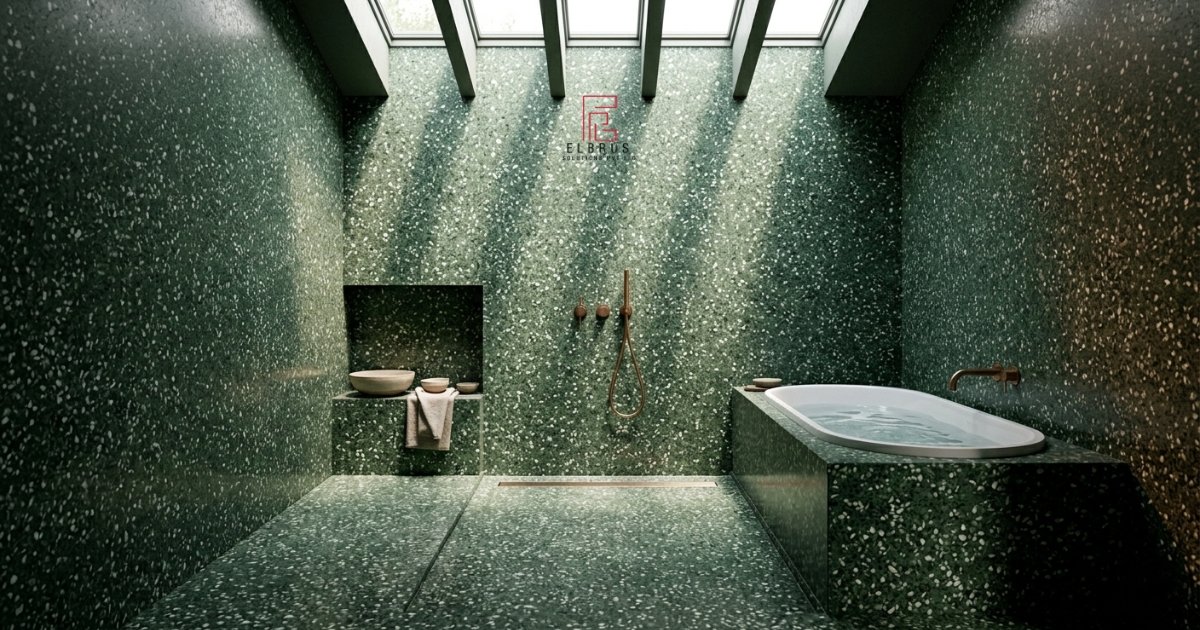
The bathroom has become terrazzo’s most dramatic stage in 2026. The trend driving the most attention — and the most aspiration — is the terrazzo design trends 2026 fully poured, seamless terrazzo bathroom: floor, walls, shower tray, and sometimes even the bath surround all cast in a single, continuous terrazzo pour with no visible joints, grout lines, or material transitions.
The effect is one of extraordinary sensory coherence. The eye travels across the entire bathroom without interruption, reading the space as a single sculpted object rather than a collection of tiled surfaces. When the terrazzo is polished to a high gloss, these spaces take on an almost liquid quality — reflective, luminous, and deeply tactile. In matte finishes, the same approach produces something more meditative and mineral, like stepping into a natural cave smoothed by water over centuries.
Colour choices for seamless bathroom terrazzo in 2026 lean toward deep, saturated tones, inky charcoal with silver glass chips, dark forest green with pale marble and shell, or a warm chocolate brown with rose quartz and brass fleck inclusions. These rich, room-enveloping palettes turn the bathroom from a functional utility space into a genuine retreat.
06. Geometric Inlay Patterns: Terrazzo as Narrative
Beyond aggregate and colour, pattern architecture is becoming a major terrazzo design conversation in 2026. Specifically, the tradition of divider strip inlays — thin brass, zinc, or blackened steel strips set into the terrazzo matrix to create geometric or figurative designs — is being revived and elevated into something much more ambitious than its previous applications.
Contemporary designers are using these divider strips to create intricate floor medallions, abstract geometric fields, and even site-specific narrative compositions — telling the story of a place, a brand, or a family through a language of lines pressed into stone. A hotel lobby might feature a compass rose medallion in terrazzo at its centre. A residential hallway might carry a subtle grid of diamond forms in two complementary terrazzo colourways. A retail flagship might have its entire brand motif rendered in terrazzo inlay at the threshold.
The brass divider strip is the most fashionable choice in 2026 — it develops a natural patina over time, growing warmer and more characterful with every year of foot traffic, creating a floor that genuinely improves with age.
07. Terrazzo Tile Formats: Modular Flexibility Meets Craft
Not every project budget or timeline accommodates an in-situ poured terrazzo installation — and 2026’s tile manufacturers have responded with a new generation of precast terrazzo tiles that bring the material’s full aesthetic richness to more accessible specifications. What’s changed this year is the format range available: alongside the classic 300×300mm square, specifiers can now choose from large-format 600×1200mm slabs, hexagonal formats, zellige-inspired irregular shapes, and even three-dimensional relief tiles that add a sculptural dimension to the terrazzo wall.
The quality of precast terrazzo tile has also improved dramatically. Advances in pressing and curing technology mean that modern tiles achieve aggregate distribution and surface polish quality that is virtually indistinguishable from poured-in-place terrazzo — removing what was historically the key visual argument against the tile format. Combined with the installation flexibility and replaceability that tiles offer, the case for specified terrazzo tile in 2026 is stronger than it has ever been.
✦ Tile Format Selection Guide
- Large format slabs (600×1200mm+): Best for floors and feature walls where continuity of pattern is the priority.
- Classic squares (300×300mm): Flexible, easy to replace, ideal for commercial and high-traffic applications.
- Hexagonal format: Brings a retro-contemporary energy — excellent for bathrooms and kitchens.
- Relief / 3D tiles: Used sparingly as a feature wall element — dramatic in hospitality and retail environments.
Ancient Material, Boundless Future
What makes terrazzo so compelling in 2026 is the way it manages to honour its deep past while remaining genuinely open to reinvention. Its fundamental logic — fragments of beauty, bound together, polished until they shine is a metaphor that designers keep finding new ways to tell.
This year, terrazzo is telling that story in spaces and scales it has never inhabited before. It is on walls and ceilings, around bathtubs and beneath dining tables. It is made from recycled glass and sunken seashells. It carries the memory of demolished buildings and the confidence of a living material that is not finished evolving.
Whether you are drawn to the bold drama of macro-chip patterning, the quiet refinement of tonal earthen palettes, or the sustainability credentials of bio-resin formulations, terrazzo in 2026 has something genuinely worth stopping for.