

Choosing flooring is more than selecting a colour or pattern. The right surface should match the way a space is used, the level of traffic it receives, the desired design language, maintenance requirements, and the long-term expectations of the project.
Two options that frequently enter this discussion are terrazzo and conventional ceramic, porcelain or vitrified tiles. Tiles are familiar, widely available and offered in countless styles, while terrazzo brings a distinctive combination of durability, customisation and continuous surface design.
So, when comparing terrazzo vs tiles, which one should you choose?
The answer depends on your project. For homeowners and designers looking for easy product availability and a broad catalogue of ready-made patterns, conventional tiles can be practical. For projects where longevity, custom design, visual continuity and architectural character are priorities, terrazzo can offer major advantages.
Let us compare both flooring options in detail.
What Is Terrazzo Flooring?
Terrazzo is a composite surface created by combining aggregates such as marble, quartz, granite or glass with a cementitious or resin-based binder. The surface is then processed, ground and polished to reveal the aggregate pattern.
Modern terrazzo can be used for floors as well as walls, stairs, countertops and other architectural surfaces. The National Terrazzo & Mosaic Association describes terrazzo as a durable, low-maintenance material with extensive design possibilities.
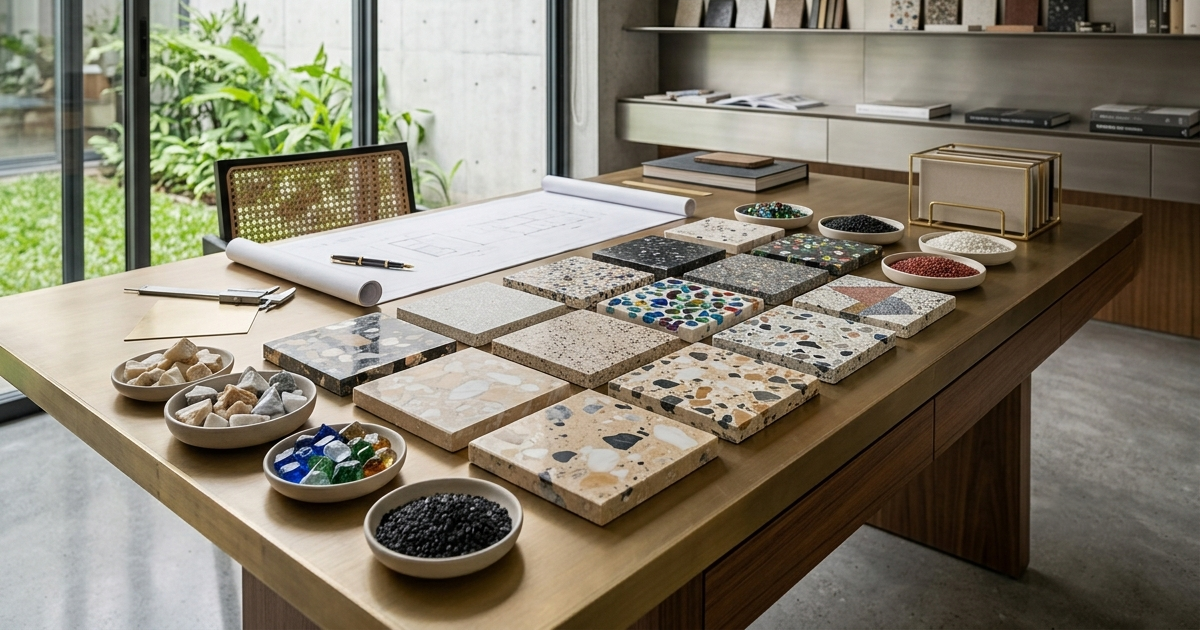
One of the biggest advantages of terrazzo is its ability to be customised. Designers can select aggregate size, colours, patterns, proportions and finishes to create a surface that works with a particular interior concept.
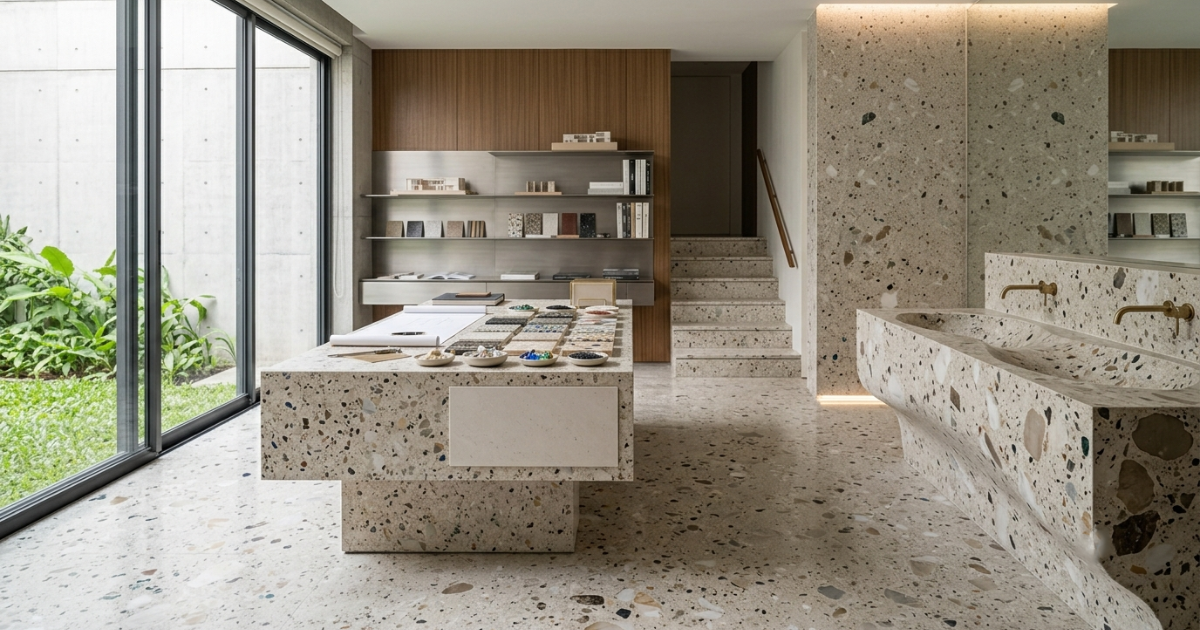
At Elbrus Solutions, terrazzo is part of a broader architectural material range that includes flooring, wall panels incorporating marble, glass, copper and brass inlays, stair treads, table tops, vanities, basins and bathtubs.
What Are Conventional Floor Tiles?
In this comparison, tiles refers primarily to conventional ceramic, porcelain and vitrified flooring products.
These products are manufactured as individual units and are available in a huge range of sizes, colours, textures and patterns. Porcelain, in particular, is a dense and low-absorption option commonly used for floors, wet areas and high-traffic applications.
Tiles are popular because they are familiar to contractors and consumers, relatively straightforward to install and readily available through a large distribution network.
However, the final appearance usually depends on the individual tile format and the grout joints between pieces.
Terrazzo vs Tiles: Detailed Comparison
| Feature | Terrazzo | Conventional Tiles |
|---|---|---|
| Appearance | Custom and highly distinctive | Wide range of ready-made designs |
| Design flexibility | Very high | High |
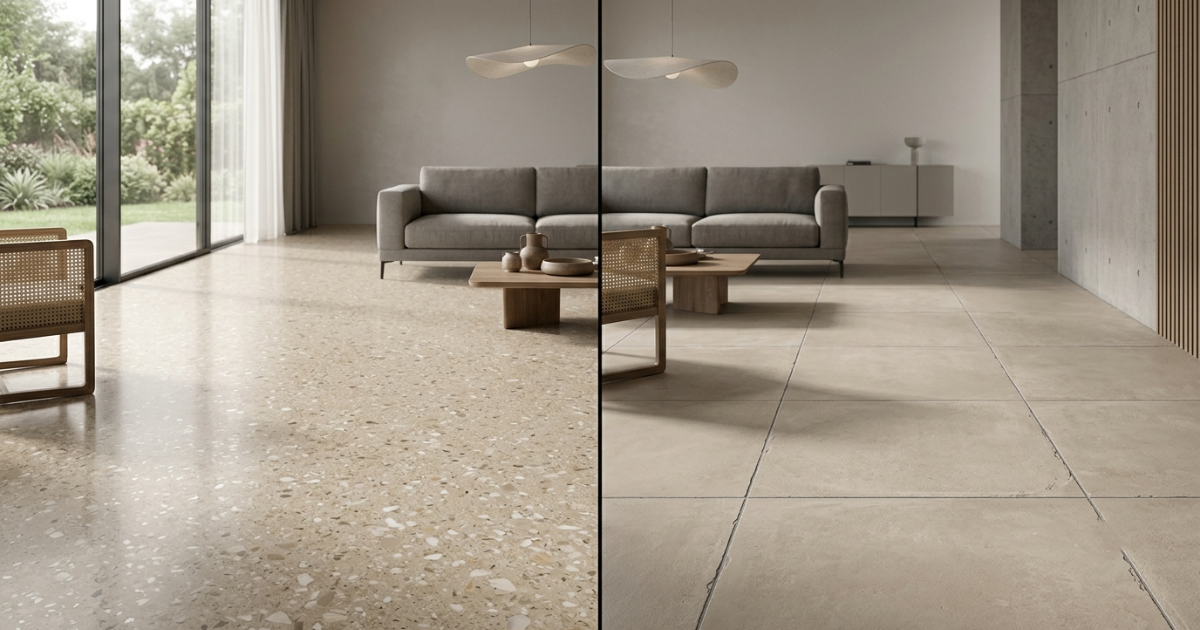
| Surface continuity | Can create a visually continuous appearance | Grout joints are generally visible |
| Durability | Excellent when correctly specified and installed | Good to excellent depending on product |
| Maintenance | Generally straightforward | Generally straightforward, with grout requiring attention |
| Customisation | Colours, aggregates, patterns and finishes can be customised | Mostly limited to available collections |
| Installation | Requires skilled installation and finishing | Familiar and comparatively straightforward |
| Replacement | Repair and refinishing can be possible depending on system | Individual damaged units can often be replaced |
| Sustainability potential | Can incorporate recycled aggregates | Depends on product, manufacturing and lifecycle |
| Best suited for | Premium residential, commercial and architectural projects | Residential and commercial applications across budgets |
1. Design Flexibility
This is one of the clearest differences between terrazzo and conventional tiles.
Tiles typically come in predefined collections. You choose from the available colours, patterns, formats and surface finishes.
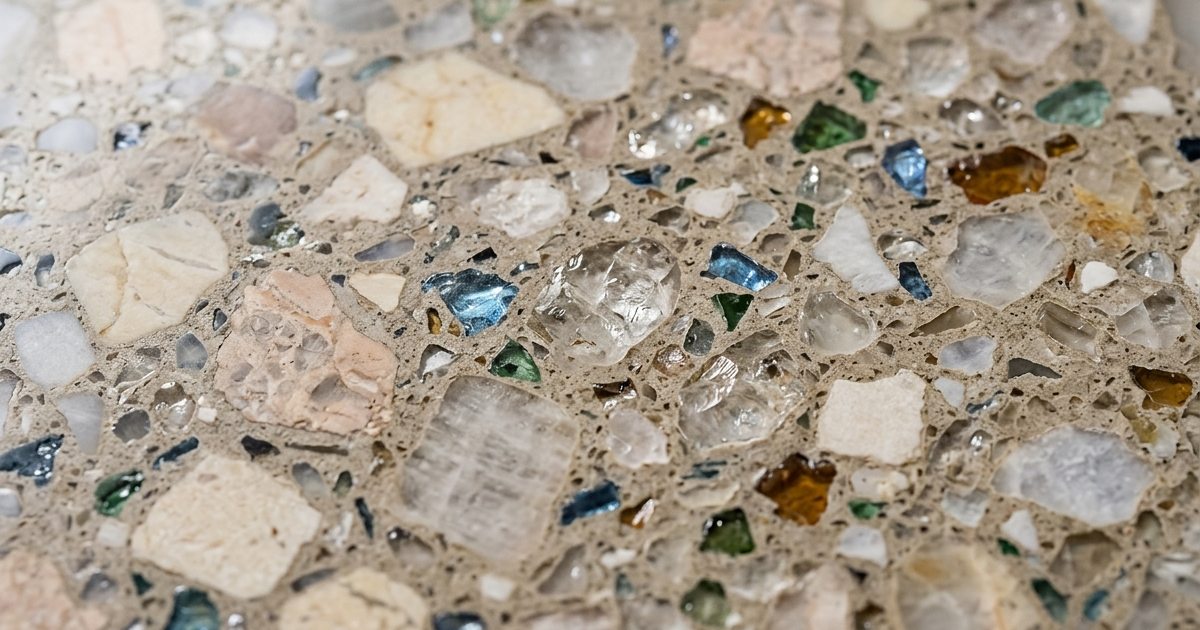
Terrazzo provides much more room for specification. Aggregate colour, aggregate size, base colour and pattern can be coordinated with an interior scheme. Marble, glass and other aggregates can also be incorporated into the design.
For architects and interior designers working on customised projects, this can make terrazzo particularly attractive.
A neutral terrazzo surface with small aggregates can create a subtle architectural background, while larger chips and contrasting colours can make the floor a major visual feature.
Winner for design customisation: Terrazzo
2. Durability and Long-Term Performance
Flooring in an entrance, office, hotel, retail space or public building may experience significant daily traffic. In these environments, durability becomes one of the most important considerations.
Well-designed terrazzo systems are recognised for their long service life and durability. The National Terrazzo & Mosaic Association notes that terrazzo has a long performance history and is used for demanding architectural applications.
Quality porcelain and other high-performance tiles can also provide excellent durability, particularly when the appropriate product has been selected for the expected traffic and environment.
The real question is therefore not simply whether one material is “stronger”, but whether the material, thickness, installation method, substrate and finish are appropriate for the application.
Winner: Depends on specification, but terrazzo has a strong advantage for long-life architectural flooring.
3. Maintenance and Cleaning
Both terrazzo and tiles can be relatively easy to maintain when the correct products and cleaning methods are used.
With terrazzo, routine cleaning generally involves removing dust and dirt followed by suitable damp cleaning. The National Terrazzo & Mosaic Association recommends regular cleaning and prompt removal of spills to help protect the surface.
The difference becomes more noticeable around joints.
Conventional floor tiles are installed individually, meaning grout lines are normally part of the finished floor. These joints can collect dirt and may require additional cleaning over time.
A properly designed terrazzo floor can provide a visually continuous surface with fewer or no conventional grout joints, depending on the terrazzo system.
Winner: Terrazzo for continuous-surface applications
4. Grout Lines and Visual Continuity
One reason designers choose terrazzo is the possibility of creating a smooth, continuous visual field.
Conventional tiles are modular. Even when large-format products are selected, joints remain part of the installation.
This is not necessarily a disadvantage. Grout lines can contribute to a tile design and help define the geometry of a room.
However, for minimalist interiors, expansive lobbies and sophisticated commercial environments, designers may prefer the uninterrupted character that terrazzo can provide.
5. Customisation Options
Imagine designing flooring around a company’s brand colour, a home’s material palette or a hotel’s interior concept.
With conventional tiles, you generally select a product from an existing range.
Terrazzo can provide significantly greater control over the finished appearance. The aggregate combination, colour balance and pattern can be developed around the design requirements.
Elbrus Solutions specifically works with different colours, textures and terrazzo compositions and offers terrazzo products across flooring and architectural applications.
Winner: Terrazzo
6. Installation and Project Requirements
Conventional tiles are widely understood by flooring contractors, making them familiar for many residential and commercial projects.
Terrazzo installation can involve additional stages depending on the selected system. Preparation, laying or pouring, curing, grinding and polishing may all form part of the process.
That means terrazzo should be planned with the right technical team and installation methodology.
For projects where craftsmanship, surface continuity and a customised finish are important, the additional planning can be worthwhile.
Winner for simpler conventional installation: Tiles
7. Repair and Replacement
Tiles have one practical advantage: because flooring is modular, an individual damaged unit can often be removed and replaced.
Terrazzo is different. Depending on the system and damage, repair may involve filling, grinding, polishing or refinishing rather than simply replacing one square.
However, terrazzo’s long-life characteristics mean that the correct comparison should consider whole-life performance, not only the ease of replacing an individual piece.
Terrazzo is recognised for long service life and low-maintenance characteristics, particularly when correctly installed and maintained.
Is Terrazzo More Expensive Than Tiles?
Initial price is one of the most common questions when comparing terrazzo vs tiles.
There is no universal answer because the price of both materials varies dramatically according to quality, format, design, installation requirements, project size and supplier.
Standard conventional tiles can be attractive for budget-focused projects because mass-produced products are widely available.
Terrazzo can have a higher initial investment, particularly when a customised design, premium aggregates or specialised installation is involved.
However, a flooring decision should not be based only on purchase price.
Consider:
Initial material cost + installation + maintenance + repairs + replacement + expected service life
A material with a higher initial price can make sense when it provides longer service, distinctive design value and lower long-term intervention.
Sustainability: Terrazzo vs Tiles
Sustainability is becoming increasingly important in architecture and interior design.
Terrazzo can incorporate recycled or recovered aggregates, including glass and other materials, depending on the formulation. The National Terrazzo & Mosaic Association highlights durability, resource efficiency, recycled content and lifecycle characteristics among terrazzo’s sustainability advantages.
Elbrus Solutions also places sustainability at the centre of its product approach and states that it uses environmentally responsible materials in its terrazzo production.
Tiles can also be produced with increasingly resource-conscious manufacturing processes, but sustainability varies considerably between manufacturers and products.
The best approach is to evaluate the complete lifecycle and specification of the actual product, rather than assuming that one category is automatically sustainable.
Which Flooring Is Better for Indian Homes?
Both options can work well in Indian homes.
Choose conventional tiles when:
You want a large selection of readily available designs, need a familiar installation process or are working within a tightly controlled initial budget.
Tiles are particularly practical when easy availability and straightforward replacement are important.
Choose terrazzo when:
You want a customised surface, a distinctive architectural appearance, excellent long-term durability or a flooring design that feels integrated with the overall interior.
Terrazzo can be particularly effective in living rooms, luxury residences, entrances, kitchens, corridors and other spaces where flooring is intended to contribute strongly to the design.
Which Is Better for Commercial Spaces?
Commercial flooring often has different priorities from residential flooring.
Hotels, offices, retail stores, restaurants, showrooms and public spaces may need to deal with heavy foot traffic while maintaining a polished visual identity.
Terrazzo has a long history in demanding public and commercial environments because of its durability and design flexibility.
For a premium commercial project, terrazzo can also help create a distinctive brand environment through custom colours, aggregates and patterns.
For standardised projects where speed, product availability and straightforward replacement are the main priorities, high-quality porcelain or other commercial-grade tiles can still be an excellent choice.
Terrazzo vs Tiles: Which One Should You Choose?
There is no single flooring material that is perfect for every project.
Choose tiles when your priority is:
- Ready-made designs
- Broad market availability
- Straightforward installation
- Easy individual-unit replacement
- Lower initial investment options
Choose terrazzo when your priority is:
- Custom design
- Long-term durability
- Visual continuity
- Architectural character
- Premium commercial or residential interiors
- Material customisation
- Sustainable design possibilities
For designers who want flooring to become part of the architecture rather than simply a finished surface, terrazzo can offer much greater creative freedom.
Why Consider Elbrus Solutions for Terrazzo?
Elbrus Solutions specialises in terrazzo and concrete products and presents terrazzo as a material that can extend far beyond conventional flooring.
Its current product range includes terrazzo flooring, wall panels with marble, glass, copper and brass inlays, stair treads, table tops, furniture, vanities, basins and bathtubs.
The company’s design approach focuses on colour, texture, aggregate composition and form, making terrazzo suitable for both functional surfaces and customised architectural applications.
For a project where flooring needs to combine durability, individuality and architectural design, terrazzo is worth serious consideration.
Final Verdict: Terrazzo or Tiles?
When comparing terrazzo vs tiles, the better option depends on your project’s priorities.
Tiles remain an excellent and practical flooring solution for many residential and commercial applications. Their availability, product variety and familiar installation make them a reliable choice.
Terrazzo, however, stands apart when the brief calls for customisation, longevity, continuous visual character and a stronger connection between material and architecture.
For premium residences, hospitality spaces, offices, retail environments and architectural projects, terrazzo can turn an ordinary floor into an integral part of the interior design.
The smartest flooring decision is therefore not simply about choosing the cheaper material. It is about selecting a surface that performs well, complements the architecture and continues to deliver value throughout its service life.
Looking for customised terrazzo flooring and architectural surfaces? Explore Elbrus Solutions for terrazzo products designed for modern residential and commercial spaces.
Frequently Asked Questions
Is terrazzo better than tiles?
Neither material is universally better. Tiles are strong in availability, standardisation and installation flexibility, while terrazzo offers exceptional design customisation, durability and continuous-surface possibilities.
Is terrazzo flooring suitable for high-traffic areas?
Yes. Terrazzo has a strong history of use in high-traffic commercial and public environments when the correct system and specification are used.
Is terrazzo difficult to maintain?
Properly specified terrazzo is generally considered a low-maintenance flooring material. Routine cleaning and appropriate maintenance practices help protect its finish.
Can terrazzo be customised?
Yes. Colour, aggregate type, aggregate size, pattern and finish can be customised depending on the terrazzo system and manufacturer.
Which is more sustainable: terrazzo or tiles?
The answer depends on the exact product and manufacturing process. Terrazzo can incorporate recycled aggregates and has strong lifecycle durability characteristics, making sustainability one of its important advantages.